
ACCESS
AUTHOR
Hanum Resti Saputri
Undergraduate Student, Department of Silviculture, Faculty of Forestry and Environment, IPB University, Bogor Regency 16680, Indonesia
Rahmat Asy’Ari
IPB Sustainable Science Research Student Association (IPB SSRS Association), IPB University, Bogor Regency 16680, Indonesia
Abd Malik A Madinu
Undergraduate Student, Department of Geophysics and Meteorology, Faculty of Mathematics and Natural Sciences, IPB University, Bogor Regency 16680, Indonesia
Ali Dzulfigar
Undergraduate Student, Department of Silviculture, Faculty of Forestry and Environment, IPB University, Bogor Regency 16680, Indonesia
Khairani Putri Marfi
Undergraduate Student, Department of Silviculture, Faculty of Forestry and Environment, IPB University, Bogor Regency 16680, Indonesia
Fajar Raihan
Undergraduate Student, Department of Silviculture, Faculty of Forestry and Environment, IPB University, Bogor Regency 16680, Indonesia
Muhammad Hisyam Fadhil
Undergraduate Student, Department of Silviculture, Faculty of Forestry and Environment, IPB University, Bogor Regency 16680, Indonesia
Salsa Fauziyyah Adni
Undergraduate Student, Department of Silviculture, Faculty of Forestry and Environment, IPB University, Bogor Regency 16680, Indonesia
Intan Nur Rahmadhanti
Undergraduate Student, Department of Silviculture, Faculty of Forestry and Environment, IPB University, Bogor Regency 16680, Indonesia
Eka Sartika Nugraha
Undergraduate Student, Department of Silviculture, Faculty of Forestry and Environment, IPB University, Bogor Regency 16680, Indonesia
Erianto Indra Putra
Department of Silviculture, Faculty of Forestry and Environment, IPB University, Bogor Regency 16680, Indonesia
Istomo Istomo
Department of Silviculture, Faculty of Forestry and Environment, IPB University, Bogor Regency 16680, Indonesia
Neviaty Putri Zamani
Department of Marine Science and Technology, Faculty of Fisheries and Marine Science, IPB University, Bogor Regency, 16680, Indonesia
Rahmat Pramulya
Research Center for Low Carbon Development, University of Teuku Umar, Aceh, Indonesia
Yudi Setiawan
Center for Environmental Research, IPB University, Bogor Regency 16680, Indonesia
ABSTRACT
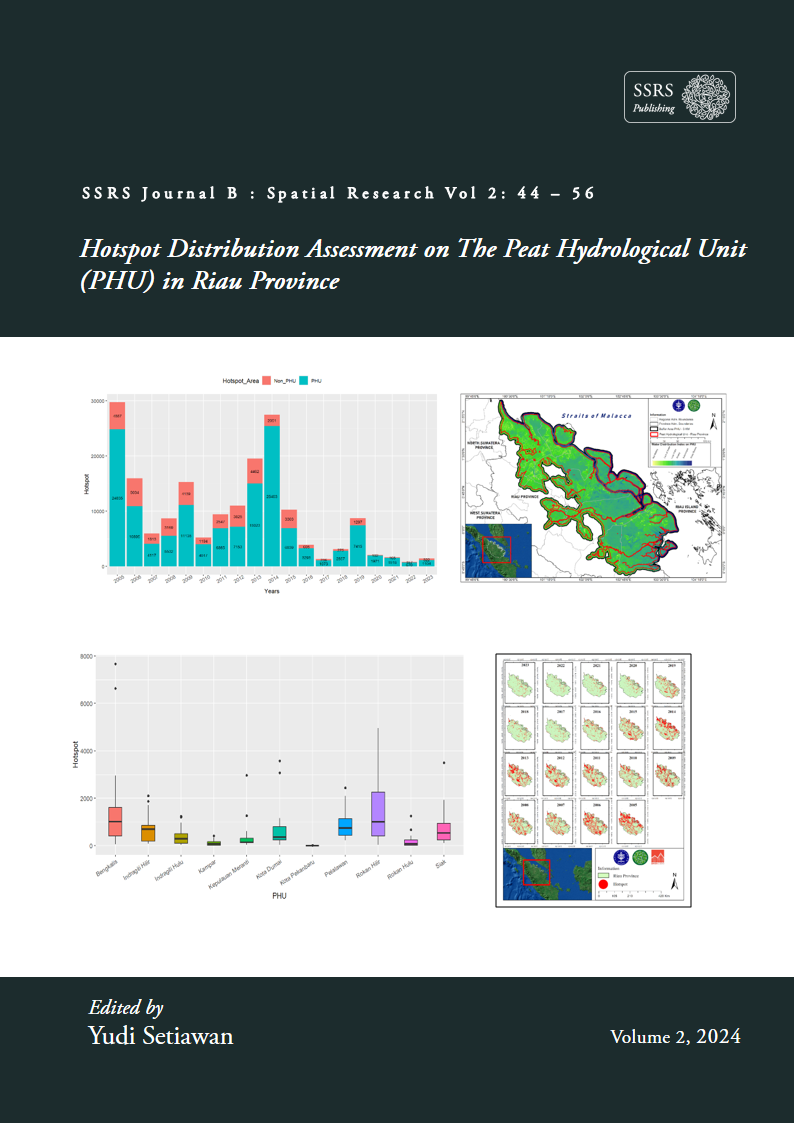
Indonesia is the third country with the largest tropical forest area in the world after Brazil and Congo. However, as time goes by the area of forest in Indonesia is decreasing. One of the dominant causes of forest destruction in Indonesia is forest fires. The type of forest that is frequently and susceptible to forest fires is forest on peatlands. Monitoring the distribution of hotspots is an important strategy in preventing forest fires on peatlands. Therefore, this research was carried out to design a platform for monitoring forest and land fires in forests on peatlands using a case study location in Riau Province. This monitoring platform utilizes remote sensing technology which uses NASA FIRMS MODIS hotspot data, BMKG rainfall data, and Sentinel-2 hydrology data. During the period 2005-2023, the most hotspots were found in 2005-2015, while the fewest hotspots were found in 2016-2023. The accumulated hotspot data is found in peat soil (PHU) as many as 138,523 hotspot (77.8%), while in mineral soil (non PHU) there are 39,583 points (22.2%). Riau Province, especially Rokan Hilir, Bengkalis and Pelalawan Regencies, are districts that require special attention in efforts to prevent forest and peatland fires because they have been detected to have the largest distribution of hotspots.
CITATION
Saputri, H. R., Asy’Ari, R., Madinu, A. M. A., Dzulfigar, A., Marfi, K. P., Raihan, F., Fadhil, M. H., Adni, S. F., Rahmadhanti, I. N., Nugraha, E. S., Putra, E. I., Istomo, I., Zamani, N. P., Pramulya, R., & Setiawan, Y. (2024). Hotspot Distribution Assessment on The Peat Hydrological Unit (PHU) in Riau Province. SSRS Journal B: Spatial Research, 2, 44–56.
Leave a Reply