Monitoring Model for Coral Reef Ecosystems Affected by Mining Sedimentation on the Coast of North Konawe Regency
Kata Kunci:
North Konawe, Coral Reef Ecosystem, Mining Activity, Monitoring, Remote sensingAbstrak
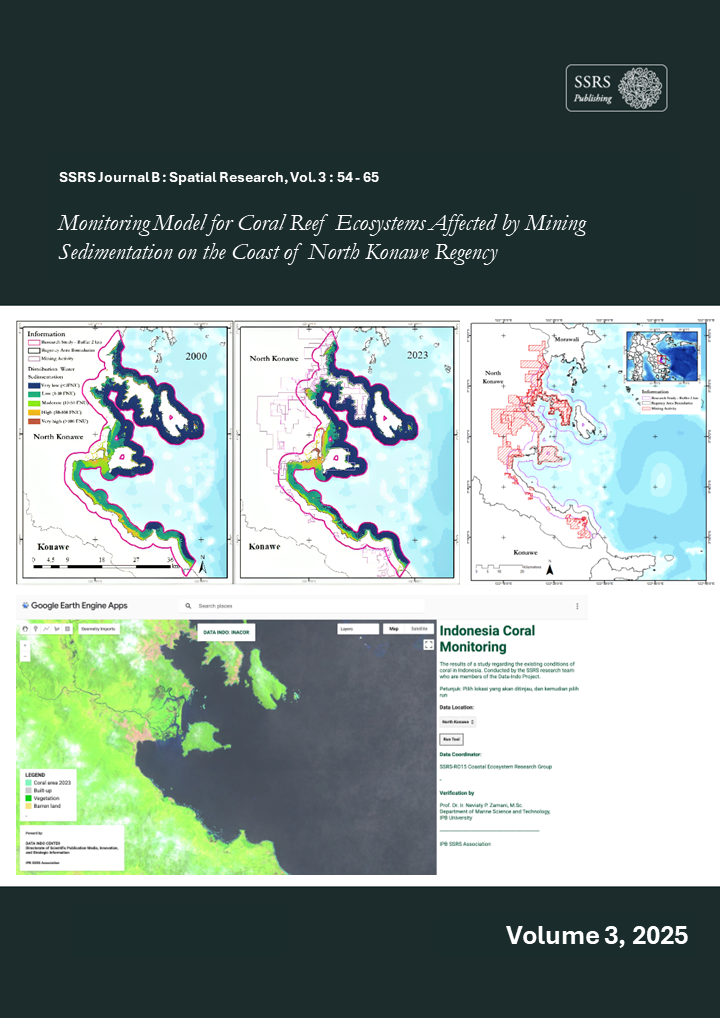
Coral reefs support ocean life by providing habitats for marine life. The great potential of coral reefs has led to massive exploitation that degrades coastal ecosystems. The development of the mining industry damages coral reef ecosystems because it produces tailings from the remaining mining of valuable minerals from the mining industry. This research aims to develop an innovative model for monitoring coral reef ecosystems affected by mining sedimentation using the cloud computing-based DATAINDO InaCor platform for carbon cycle sustainability in the North Konawe Coast. This research uses the Landsat 5 satellite series with 7 TM and 4 MSS spectral bands to obtain classification data and the North Konawe coast mapping in 2000. Landsat 8 with 9 OLI-2 spectral bands and 2 TIRS-2 spectral bands was also used to obtain the same data in 2023. Through satellites, the differences in coastal conditions of North Konawe Regency between 2000 and 2023 are visible. This difference is caused by changes that occur in the form of a decrease in vegetated land to 28340.14 ha from 33776.46 ha and coral reef area from 5968.08 ha to 1388.79 ha. This was caused by the expansion of coastal mining that converted vegetated land and produced tailings that flowed into the sea, causing damage to coral reefs. High turbidity index values characterize coral reef damage, and chlorophyll index values can be seen from the analysis results through remote sensing.