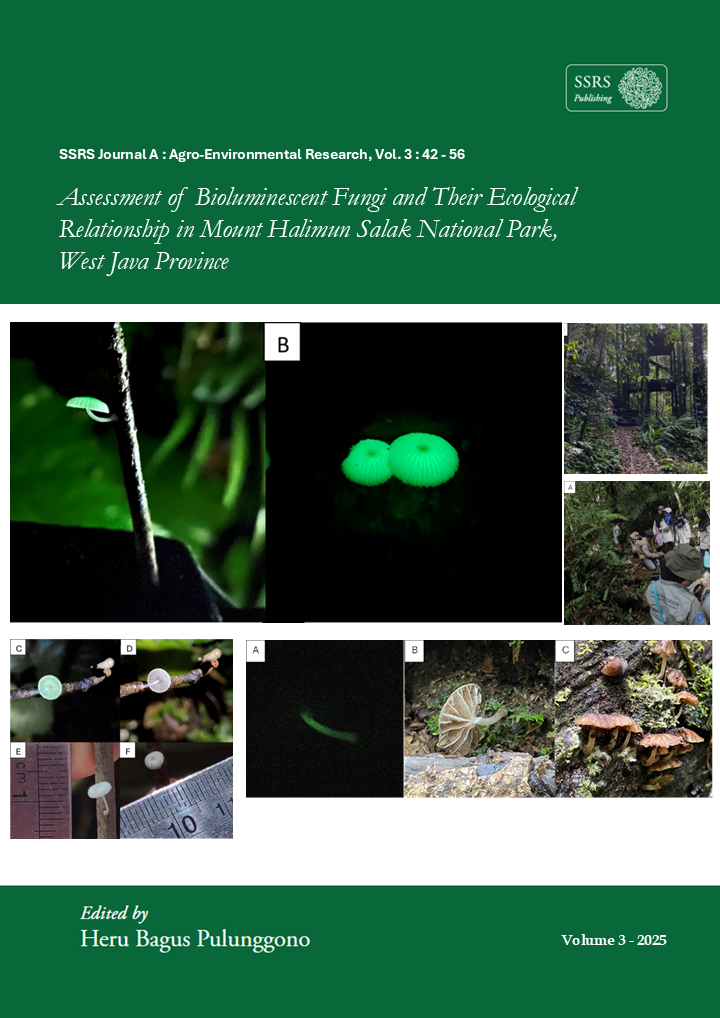
Assessment of Bioluminescent Fungi and Their Ecological Relationship in Mount Halimun Salak National Park, West Java Province
Keywords:
Bioclimate, Bioluminescent Fungi, MycenaAbstract
Bioluminescent fungi are fungi that possess unique structures and are capable of emitting light (bioluminescence). Gunung Halimun Salak National Park (GHSNP) is one of the habitats of bioluminescent fungi, with its ecosystem consisting of tropical rainforest and high rainfall. The research conducted aimed to determine the bioecology of the habitat, including air temperature, air humidity, substrate pH, shading vegetation, macromorphology, and population density of bioluminescent fungi. Data collection was carried out during night and day using the purposive random sampling method in two observation plots at the Cikaniki Research Station, GHSNP. The ecological data collected included air temperature and humidity, which were gathered as time series data, and canopy cover, analyzed using hemispherical photography. Results showed that bioluminescent fungi inhabit moist environments with substrates consisting of dead wood or litter layers that have an acidic pH. Based on time series collection, bioluminescent fungi experience daily air temperatures ranging from 20–24 °C and air humidity levels between 84–98%. Two species of bioluminescent fungi were found in both observation plots, namely Mycena sp., characterized by white fruiting bodies measuring 1.2 cm, and Species X, which remains unidentified. Population density in Plot 2 was higher compared to Plot 1, reaching 9 individuals per plot. The type of vegetation in the habitat of bioluminescent fungi in Plot 2 was also more diverse and accompanied by understory plants such as begonias, palms, and ferns, resulting in a more humid habitat and a greater distribution pattern in Plot 2 compared to Plot 1. Differences in population density between plots of bioluminescent fungi in each plot indicate that habitat and environmental factors influence the distribution pattern and growth of bioluminescent fungi.
Downloads
Published
How to Cite
Issue
Section
License
Copyright (c) 2026 Danik Septianingrum

This work is licensed under a Creative Commons Attribution 4.0 International License.