Spatio-temporal analysis of Mangroves in Subang Regency using Sentinel-2 TimeSeries Data
Abstract
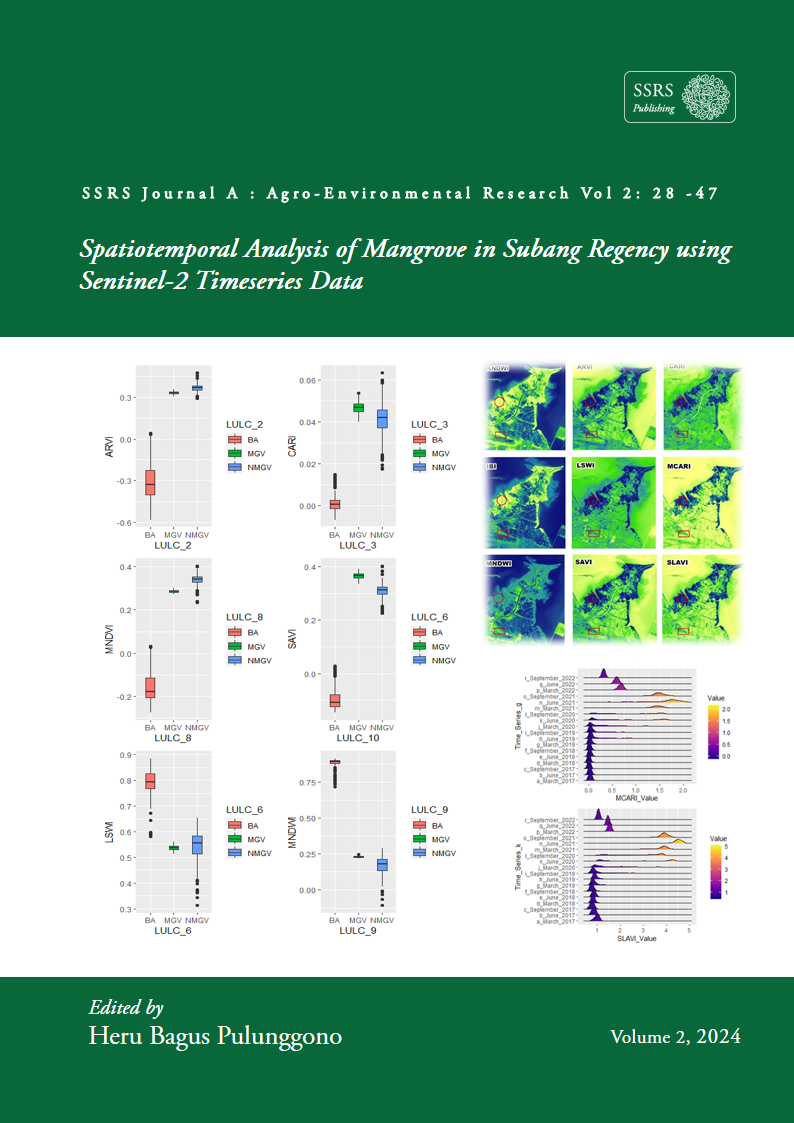
The mangrove forest ecosystem is one of the types of ecosystems that grow in the tidal areas of the ocean and play an essential role in addressing global issues such as climate change. Remote sensing technology can be used to monitor mangrove areas accurately and efficiently. This study aims to detect the spatiotemporal distribution of mangroves from 2017 to 2022 using remote sensing techniques, identify the spectral characteristics and threshold values of the indices involved in mangrove area detection, and determine the accuracy of mangrove area detection in Subang Regency, West Java. Mangrove area detection is carried out using Land Use Land Cover (LULC) classification involving several vegetation, water, and built-up indices to obtain the mangrove area from 2017 to 2022. The research results showed that the mangrove area was 1972.98 ha and distributed in areas A, B, C, and D. Area D showed an increase in mangrove area due to natural succession or planting.The spectral vegetation index tends to increase while the water index and built-up index tend to decrease. MNDWI has the ability to distinguish between mangrove and non-mangrove vegetation. The research results show that there are examples of mangrove succession points (area D) which can be used as a consideration for policy-making to optimize the role and function of mangroves as a natural barrier.
Downloads
Published
How to Cite
Issue
Section
License
Copyright (c) 2024 Ali Dzulfigar, Rahmat Asy'Ari, Azelia Dwi Rahmawati, Aulia Ulfa, Khairani Putri Marfi, Raditya Febri Puspitasari, Sylva Puspita, Julita Catri Adila, Lalita Mahardika Putri Firmansyah, Neviaty Putri Zamani, Rahmat Pramulya, Yudi Setiawan

This work is licensed under a Creative Commons Attribution 4.0 International License.