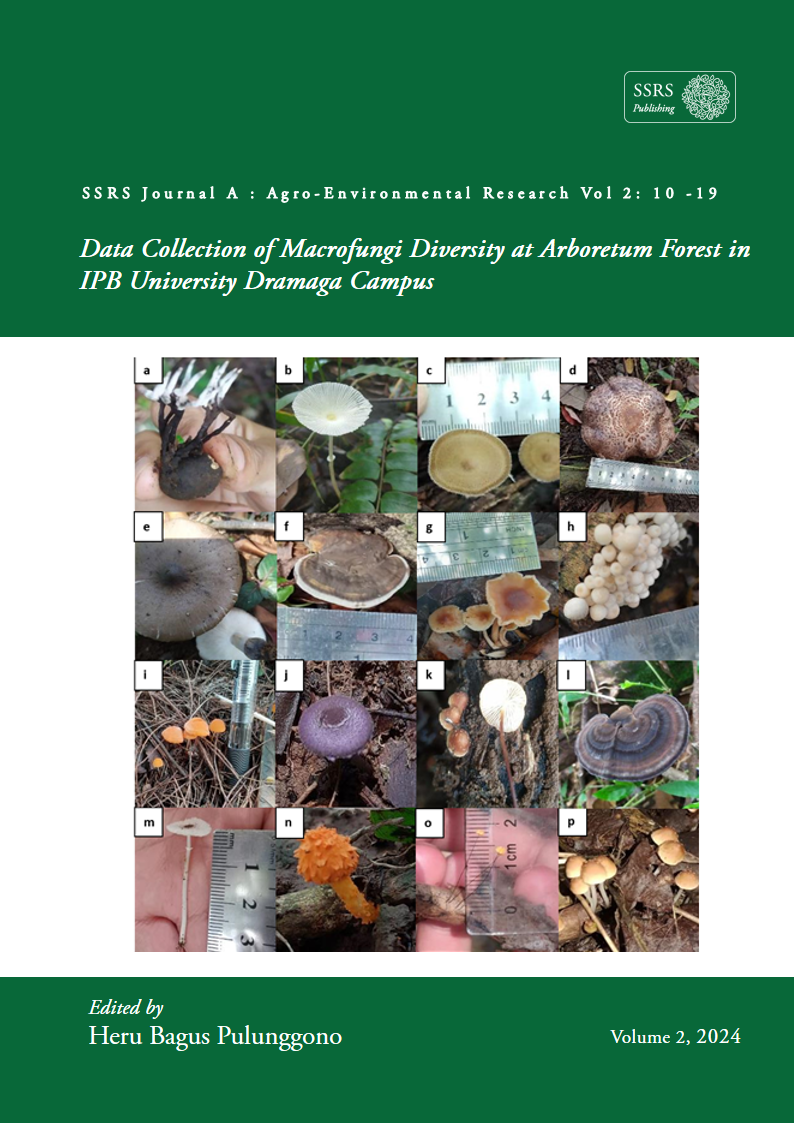
Data Collection of Macrofungi Diversity at Arboretum Forest in IPB University Dramaga Campus
Keywords:
Ascomycota, Basidiomycota, Ecology, Inventorisation, IPB ForestAbstract
Characteristics of forests can affect the species richness of macrofungi. Macrofungi data was collected based on three forest areas in the IPB University Campus Forest: conservation parks, inspiration lakes, and bamboo arboretums. Data was collected by opportunistic methods and by recording macroscopic morphological characters. The results showed that 16 species were identified (1 species of the order Xylariales, 11 species of the order Agaricales, and four species of the order Polyporales). The species with the highest diversity distribution were at station 1 (dominating 80%). This is because station 1 has a higher shade density and more diverse vegetation types. Macrofungi found growing on various substrates ranging from litter (types include Marasmius sp3.), soil (Leucocoprinus sp., Agaricus sp., Collybiopsis sp., Termitomyces sp., and Cystoagaricus sp.), soil mixed with litter (Enrtoloma sp.), african seeds (Xylaria sp.), twigs (Marasmius sp2.), weathered wood (Lentinus sp., Lepiota sp., Marasmius sp1., Coprinellus sp., Ganoderma sp., Amauroderma sp. and Deconia sp.). It is noteworthy that the discovery of Entoloma sp. in this urban forest is a rare occurrence.
Downloads
Published
How to Cite
Issue
Section
License
Copyright (c) 2024 Nurah Anggraeni, Muhammad Hisyam Fadhil, Danik Septianingrum, Faiza Utami, Alya Raisa Karina, Ardian Putra Fernando, Sindi Permanik Maharani, Rahmat Asy’Ari, Yudi Setiawan

This work is licensed under a Creative Commons Attribution 4.0 International License.